Design Director
Twilio · Conversational AI
Designing
the agentic
era.
Leading design across Twilio's Conversational AI portfolio, bringing together Conversation Orchestrator, Conversation Intelligence, Enterprise Knowledge and Customer Memory.
01 · The challenge
Making complex AI products feel simple enough to use.
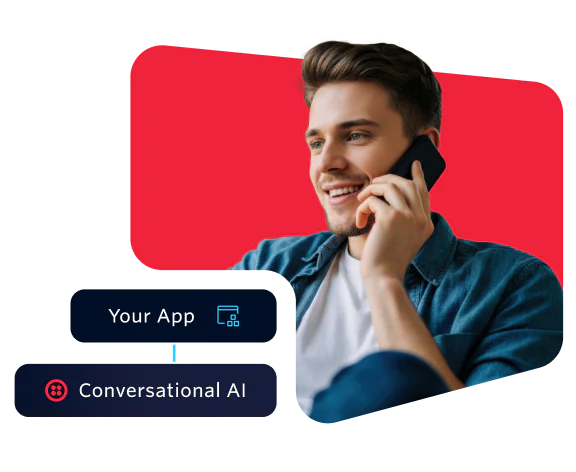
Twilio's Conversational AI portfolio brought together orchestration, intelligence, memory, knowledge and multiple communication channels.
The design challenge was not simply to create individual interfaces. It was to make the system understandable, usable and coherent for the people building real customer experiences.
02 · The system
Four products, one connected customer experience.
Twilio's Conversational AI portfolio was not a collection of isolated tools. The opportunity was to make four capabilities work together so customers could move from a disconnected interaction to a continuous, intelligent conversation.
01
Conversation Orchestrator
Connects the conversation. It brings Voice, SMS, WhatsApp, RCS and other interactions into one continuous conversation, so context can follow the customer across channels and handoffs.
Read the product story ↗02
Conversation Memory
Remembers the customer. It builds a persistent customer profile from previous interactions, preferences and context, giving human and AI agents the relevant history when they need it.
Read the product story ↗03
Enterprise Knowledge
Grounds the experience in the business. It gives agents access to trusted business information such as policies, FAQs and product documentation, so responses can be grounded in what the company actually knows.
Read the platform story ↗04
Conversation Intelligence
Understands what is happening. It analyses live conversations, turns dialogue into signals and next-best actions, and helps human and AI agents respond while the interaction is still happening.
Read the product story ↗
Together
Orchestrator connects the interaction. Memory carries the customer context. Enterprise Knowledge grounds the response. Intelligence turns the conversation into action.

The architecture behind the experience
Twilio's Conversational AI experience brought together conversation orchestration, intelligence, memory and knowledge across the communication channels customers already use. The design challenge was making those relationships understandable without exposing all of the underlying complexity.
03 · Explore the work
See the experience in motion.
The prototype starts at the core conversational AI experience. The supporting keyframes show how the team explored the relationships between Conversation Intelligence, Memory, Orchestrator and the wider platform.

Conversation Intelligence
Designing an experience for real-time analysis, GenAI operators and cross-channel conversational intelligence.
04 · The user problem
Customers were being asked to understand a system before they could experience its value.
Conversational AI introduced a new level of complexity for customers: multiple products, new concepts, new configuration models and new ways of working.
The opportunity was to shift the experience from explaining the system to helping customers experience what it could do.
05 · Design direction
Move from complexity people have to understand to capability they can experience.
Conversation Orchestrator
Turning a complex configuration model into a clear, step-by-step experience.
Conversation Orchestrator gives customers control over how conversations are configured and managed across channels.
The design challenge was making a complex system understandable without removing the flexibility experienced Twilio users expect.

Configuration experience
A progressive flow surfaces the right level of complexity at the right point in the task.
01
Progressive complexity
Keep the initial decision small. Reveal more sophisticated controls only when they become relevant to the customer's task.
02
Make system behaviour visible
Configuration becomes easier to understand when customers can see what each decision changes in the resulting experience.
03
Design around the job
Customers should not need to understand internal product boundaries before they can complete a task.
06 · User focus
Start with what the customer is trying to accomplish.
The strongest design decisions came from reframing the experience around customer intent rather than product structure.
Understand
Help customers understand what the Conversational AI platform can do before asking them to configure the system.
Explore
Let people experiment with scenarios and capabilities without requiring them to make production decisions first.
Build
Create a path from an initial idea to a configured production experience.
07 · Experience the value
Give people the "aha" moment.
One of the clearest customer problems was that customers did not understand what the products could do without seeing a demo.
The Conversations Playground became a way to experience the system rather than simply read about it.
Customers could explore an AI customer-care scenario and see how capabilities such as memory, orchestration and intelligence work together.

Conversations Playground
An interactive experience designed to help customers understand conversational AI through use rather than explanation.
08 · Design exploration
Designing the relationships between capabilities.
The work was not about designing isolated screens. It was about figuring out how intelligence, conversations, memory and configuration should work together as customers move through the product.
Intelligence
Designing how complex conversational data becomes something customers can understand, inspect and act on.
Orchestration
Structuring complex configuration so customers can understand what they are changing and why it matters.
09 · How the design was created
The work was iterative, collaborative and grounded in the real product.
This was not a linear research-to-wireframe-to-UI process. It required product strategy, systems thinking, interaction design and close collaboration with Product and Engineering.
01
Frame the customer problem
Identify where complexity was preventing customers from understanding, configuring or adopting the product.
02
Explore the interaction model
Use Figma to explore different ways of structuring configuration, navigation and relationships between capabilities.
03
Design with Product and Engineering
Work across disciplines to understand constraints, dependencies and the changes required in the underlying experience.
04
Test the experience
Use prototypes, UAT and collaborative reviews to identify usability and design-quality issues before and during release.
05
Learn and improve
Feed findings back into the product, design system and operating model rather than treating launch as the end of the design process.
10 · Design quality
Designing the quality of the shipped experience.
At this scale, design leadership is also about creating the conditions for quality.
Pattern QA
A recurring cadence for reviewing changelogs, testing releases, documenting issues, triaging bugs and retesting critical regressions.
UAT
Collaborative testing across Engineering, Product and Design using structured user-flow test matrices and issue tracking.
Design debt
Identifying design-quality issues alongside product delivery rather than allowing inconsistencies to accumulate unnoticed.
11 · Scale & impact
Design at product, organisational and business scale.
My role combined hands-on product direction with the leadership required to make a complex design organisation operate effectively.
12
Designers led across graduate through principal levels
300k+
Accounts reached through One Console rollout
$3.63M
Annual revenue associated with Conversation Intelligence
64%
YoY growth for Conversation Intelligence
12 · Leadership
The work was bigger than the screens.
As Senior Product Design Manager, I led design across a rapidly evolving Conversational AI portfolio while creating the organisational conditions for teams to do their best work.
That meant connecting product strategy, design quality, people leadership and execution across a complex organisation.
People
Leading 12 designers across graduate through
principal levels.
Product
Partnering with 8 Lead Product Managers across
the portfolio.
Engineering
Working across organisations supporting
60+ engineers.
Organisation
Annual planning, org design, hiring, performance,
budget, prioritisation and capacity planning.
13 · Further reading
The thinking and product stories behind the work.
Twilio · Product launchIntroducing Conversation Orchestrator ↗
Twilio · Product launchWhat is Conversation Intelligence? ↗
Twilio · Product launchWhat Is Twilio Conversation Memory? ↗
Twilio · Platform storyInfrastructure for the agentic era: A new conversation layer for the Twilio Platform ↗
Twilio · ResearchInside the Conversational AI Revolution ↗
What this work demonstrates
Designing clarity in complex systems.
This work sits at the intersection of product strategy,
systems thinking, interaction design and organisational
leadership.
The goal is not to make complexity disappear. It is to
make complexity understandable, useful and actionable
for the people who have to use it.